
4X4 DRIVER TRAINING – HOW TO PICK THE RIGHT INSTRUCTOR

Guest blog by Grant Spolander
Why 4×4 Training Courses Vary
Over the past 15 years or so I’ve attended almost a dozen off-road driving courses. During that time, I was often amazed at how frequently I’d learn something new. However, the greatest lesson of all has been the realization that not all 4×4 training courses are equal.
Much like any enthusiast-driven industry, the off-road market is inundated with people who have bought a 4×4, fell in love with the lifestyle, and then decided they’re going to supplement their income by training other newbie 4×4 owners on the weekend.
This problem is amplified by the fact that there’s very little accreditation governing the off-road instructor market. Things may be different in Australia or the States, but in South Africa, this is the wild, wild west of 4×4-driving instruction.
What surprised me most about many of these training courses was how conflicting the information would be between instructors. Some would tell you to wear your seatbelt through a river crossing, and others would advise that it must be removed. Some would advise against tyre deflation, while others went overboard on how low your pressures should go.

Unfortunately, because off-road situations can vary so greatly, there are very few absolute truths when it comes to off-road driving techniques. Most of the time, it comes down to experience, i.e. know your limits, know your vehicle’s limits, and know how that relates to a variety of terrain types.
In my view, the best 4×4 instructors are the ones who help you determine those limits (safely), so that you don’t have to learn them the hard way.
Terrain Considerations
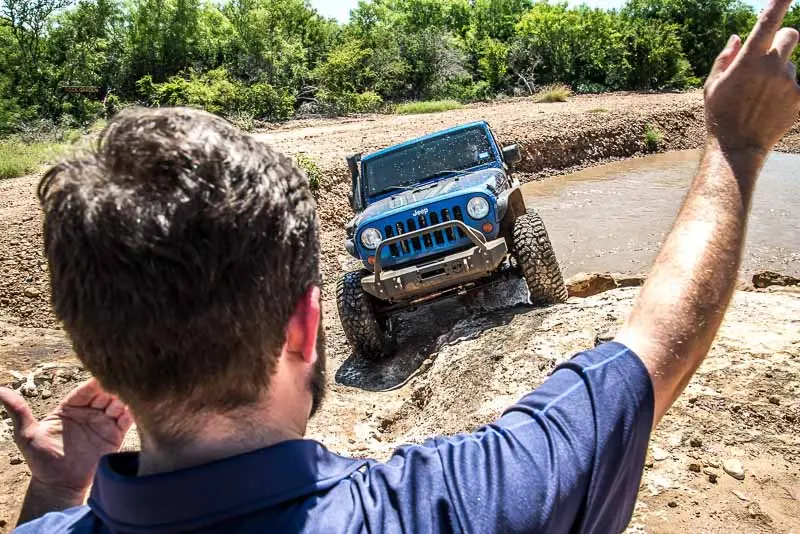
When picking a 4×4 driving instructor, it’s a good idea to start with your intended vehicle use. Generally speaking, 4×4 trail driving on the weekend is focused around intentionally seeking obstacles that push you and your vehicle to the limits. Overland travel, on the other hand, is all about protecting your vehicle and avoiding unnecessary risks.
In both cases, you should know how to navigate a variety of obstacles, but if you intend to heavily kit out your vehicle, and travel long distances to remote places, you should aim to find an off-road driving instructor who has experience in overland travel.
In some cases, you can find a 4×4 instructor who also works as an off-road tour operator. It’s a good sign if the tour company’s trips are regularly booked up, too. Tour operators also tend to think “risk first”, which includes: vehicle preservation, and just as important, tyre protection.
Tyre Training
I would be very suspicious of any 4×4 instructor who doesn’t focus heavily on tyre training. Learning about your 4×4 without learning about your tyres, is like learning about hunting rifles without learning about bullet ballistics.
That said, you need to know your tyres’ strengths, weaknesses, and how to look after them. For example: While tyre deflation is obviously beneficial in terms of off-road traction, Light Truck tyres that are designed to be puncture resistant and durable under heavy loads, are going to be more susceptible to cracking if the tyre is severely under-inflated.
In short: Proper 4×4 instruction needs to include what your tyres (not just your vehicle) can and can’t do.

Recovery Risks
Ironically, when accidents do happen off-road, it’s generally in response to a bad situation, rather than the bad situation itself.
A common example of this is when a vehicle is heavily bogged down in sand or mud – which isn’t the end of the world – but instead of using the correct equipment to free the stuck vehicle, a tow rope is used in haste. Inevitably, something hard and heavy breaks free from the bogged-down vehicle and hurtles through the air.
Knowing how to safely recover a 4×4, is like a fighter learning how to take a punch, rather than just knowing how to throw one. That said, some 4×4 training courses may not delve into the recovery aspect of off-road driving in just one day. You may need to do a 2- or 3-day course to cover that information.
One-on-One vs Group Training
Fortunately, I’ve had the privilege of training one-on-one with some of South Africa’s most well-respected 4×4 instructors; I’ve also attended several courses with large corporate groups and motoring journos. Although I’d definitely say you’re going to learn more when training one-on-one, it’s often helpful to see how various people respond to various off-road challenges. Or put another way: It’s often helpful to see what NOT to do.
That’s not to say I haven’t made mistakes off-road (I have… many, many times), however, when you get to watch someone else mess up, it can often be a great learning tool.
